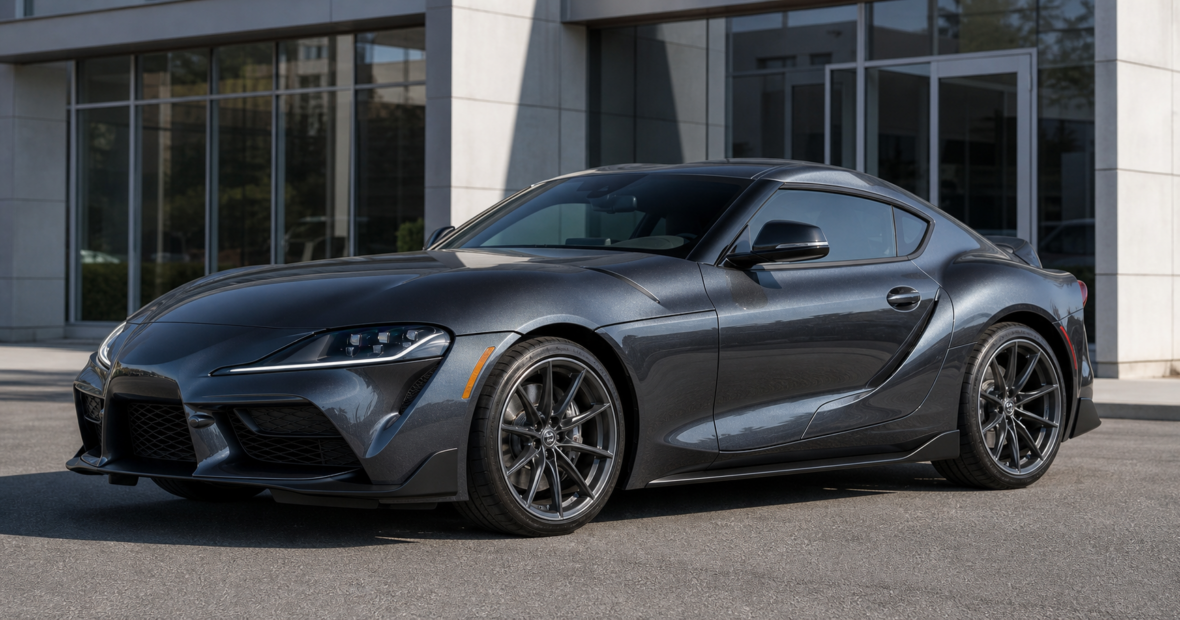
Sports car owners don’t usually expect their recall notice to show up with a German accent. But the Toyota GR Supra 2.0 has been pulled into a safety campaign alongside several BMW models, including the 330i, X3 and Z4, over a starter motor that could create a fire risk.
- The campaign covers the four-cylinder GR Supra 2.0 plus BMW’s 330i, X3 and Z4
- The concern centers on the starter motor and the possibility of a fire
- Recall work is free at franchised dealers, and owners can check their VIN before the letter arrives
What the Recall Covers
The action groups the GR Supra 2.0 with a handful of BMW vehicles built around the same hardware. The common thread is the starter motor, a part most drivers never think about until the morning it refuses to spin the engine over. In this case the worry runs the other direction. A fault in that circuit can generate enough heat to become a fire hazard, which is why regulators treat it as a safety matter rather than a warranty annoyance.
Not every car in these model lines is affected. Recalls are typically scoped to a specific production window, so two identical looking Supras built months apart can land on opposite sides of the list. The VIN is the only thing that settles it, and that goes for the six-cylinder GR Supra 3.0 too. Don’t assume your car is clear because of the trim badge on the back.
Why a Toyota Sits on a BMW Recall List
The current GR Supra came out of a joint program between Toyota and BMW. The 2.0-liter turbocharged four in the entry model is a BMW engine, and the car is built in Austria alongside the BMW Z4. Shared engineering keeps low-volume sports cars financially possible, and it’s a big reason the Supra came back at all.
The tradeoff shows up on days like this. When a shared part turns out to be faulty, the recall follows that part across every badge it was fitted to. Same supplier, same problem, four different nameplates.
What a Starter Motor Problem Actually Means
The starter draws a heavy jolt of current for a second or two every time you press the button. That current runs through thick cables and connections that have to stay tight and well insulated. When something in that path degrades, resistance climbs, heat builds, and nearby materials can be damaged. Because the starter sits in the engine bay near plenty of things that burn, manufacturers move quickly once a defect turns up.
Warning signs worth paying attention to include a burning smell after startup, slow or inconsistent cranking, blown fuses, or any electrical hiccup that appears right when you hit the button. None of those confirm you have the defect, but they’re worth mentioning when you book the car in.
Getting Your Supra Checked Before You Get the Letter
Manufacturers mail notification letters, but that takes weeks, and the letters follow registration records that go stale as cars change hands. Run your VIN through the free lookup tool at nhtsa.gov/recalls instead. It takes about a minute and shows every open recall on that specific car.
If yours comes back affected, call a franchised dealer and get on the schedule. Recall repairs cost you nothing, parts and labor included, and that applies whether you bought the car new or picked it up used three owners later. Ask what the remedy involves and whether parts are in stock, since early in a campaign the fix sometimes gets staged in phases. Shared platforms give us cars like the Supra. Shared recalls are the price of admission.