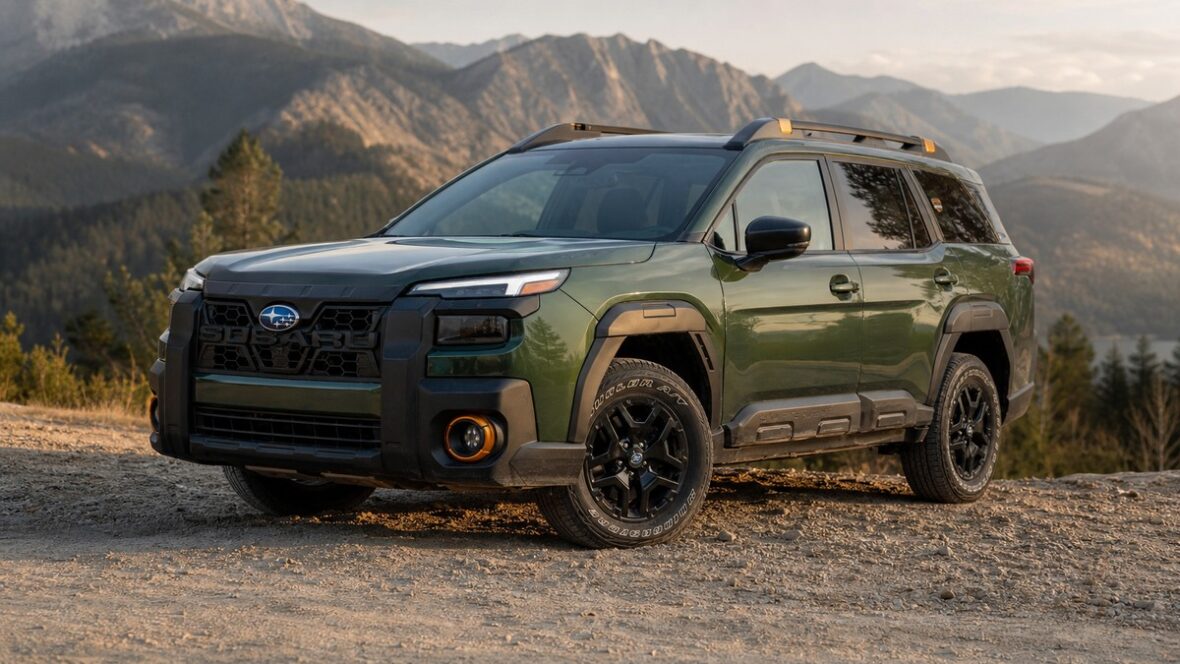
Subaru took a hard left back toward its boxy past with the 2026 Outback Wilderness, and the result is a tall, squared-off wagon that trades sleek curves for genuine usefulness. It’s a little polarizing to look at, sure, but the payoff shows up the moment you load up the family and point it at a dirt road.
- Boxier styling raises the roofline by 1.4 inches for extra headroom and better visibility
- A 2.4-liter turbo flat-four makes 260 horsepower and 277 lb-ft of torque
- Ground clearance climbs to 9.5 inches, with cargo room stretching to 80.5 cubic feet
Back to Its Boxy Roots
Everyone wants an SUV these days, and almost nobody wants a wagon unless they’ve got money to burn. Subaru clearly read the room. The new Outback shows up more upright and square than the swoopy versions that came before it, and honestly it looks like an ’80s Volvo that spent some time at the gym. The Outbacks from the ’90s and early 2000s were square right down to the headlights, so this is less a reinvention and more a return.
The Wilderness trim pushes the rugged theme further with gold trim accents and an extra 0.8 inches of ground clearance. There are a lot of textures going on outside, and the various plastic bits wear different finishes that don’t quite gel. The rear end asks a lot of your eyes. You won’t mistake it for anything but a Subaru, though, since the name is spelled out proudly across the front grille.
A Cabin Built Around Real Life
Inside, the design settles down and gets practical. The old vertical center stack is gone, replaced by a chunky 12.1-inch horizontal touchscreen and a 12.3-inch digital gauge cluster, with a real volume knob wedged between them. The interface looks a bit like what Toyota uses, but it isn’t a copy. Best of all, it boots up instantly, and wireless Apple CarPlay runs without lag or stutter.
Subaru also kept hard buttons and knobs for the entire climate system, which is a small mercy in an age of buried menus. The steering wheel buttons still click with a satisfying feel, and the stitching is tight and neat. The materials pile on a few too many finishes for one dashboard, and the available Nappa leather feels a touch fancy for a car you’ll climb into muddy after a hike.
Space is where this thing earns its keep. There’s plenty of room up front and in back, and the raised roofline delivers fantastic headroom. Cargo space behind the second row measures 34.6 cubic feet, only 3.1 cubes shy of a Jeep Grand Cherokee. Fold the rear seats and you get 80.5 cubic feet. For families juggling strollers, gear, and grocery runs, that’s the kind of number that matters.
How It Drives
Every Outback Wilderness runs the 2.4-liter turbocharged flat-four making 260 horsepower and 277 lb-ft of torque. A CVT remains the only transmission, paired with standard all-wheel drive. Subaru borrowed the bigger Ascent’s 4.44 final drive ratio to make it quicker off the line and better at crawling up a grade. The powertrain itself didn’t change from before, but the tuning feels smoother and more sorted.
The adaptive dampers are the real highlight. Despite the added ground clearance, the Outback Wilderness feels planted rather than perched up on stilts. All that tall, upright glass gives you great sightlines, a nice change from the bunker-like feel of so many new cars. One nitpick: the 225/65R17 Bridgestone Dueler A/T tires are billed as all-terrain rubber, yet they look more like street tires than the knobby set on the last generation.
What It Costs and Who It’s For
The base 2026 Outback starts at $36,445 with destination, while the Wilderness model runs $46,445. A loaded Emerald Green example checked in at $50,930 once you add a package with navigation, a power moonroof, surround-view camera, and cooled Nappa leather seats. EPA numbers land at 21 mpg city, 27 highway, and 23 combined, with a curb weight of 3,974 pounds and off-road angles of 20 degrees approach and 23.6 degrees departure.
The pitch is simple. This wagon bundles car-like driving manners with everyday practicality and all-weather grip, and nothing really competes unless you’d rather have a full SUV or a pricier luxury wagon. The looks may split opinions, but function was always the point here. For adventurous families who want room, capability, and Subaru’s dependable all-wheel drive without stepping up to something bigger and thirstier, the Outback Wilderness deserves a serious test drive.