
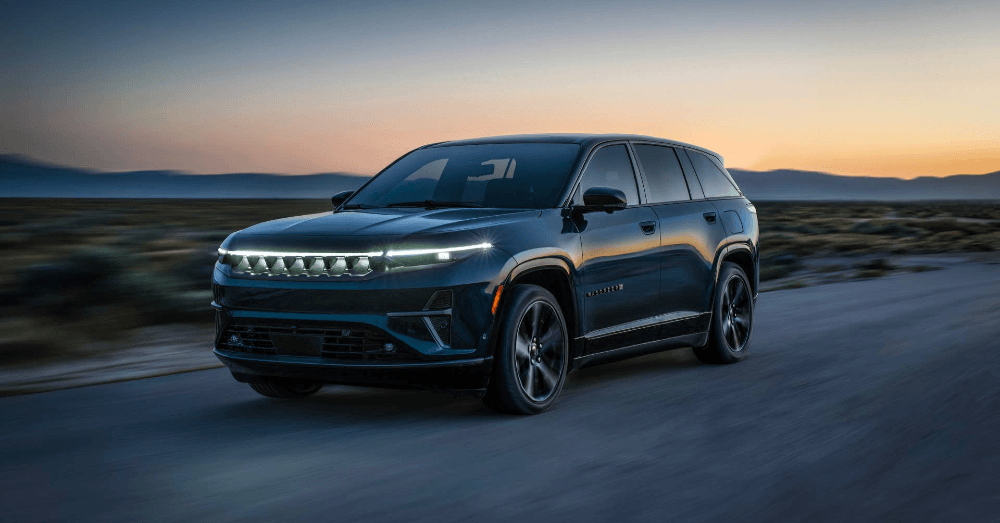
Jeep’s first U.S.-market EV is taking an unscheduled break. After watching Wagoneer S sales fall off a cliff over the past two quarters, Stellantis confirmed that the brand will skip the 2026 model year entirely and return with a refreshed 2027 version instead.
- Wagoneer S Q1 2026 sales dropped to just 175 units in the U.S.
- The 2025 model stays on sale at Jeep dealers while production pauses
- The 2027 redesign will add a native NACS port plus battery and software upgrades
How Bad Did Sales Really Get?
The numbers tell a brutal story. The Wagoneer S launched in January 2025 as Jeep’s first U.S.-market EV, positioned as a sporty, upscale electric SUV with 600 horsepower. It initially found some buyers, with Jeep selling 10,426 units over its first nine months on sale. Then the bottom fell out.
From October 2025 through March 2026, Jeep moved only 613 Wagoneer S units, and the first quarter of 2026 ended with just 175 sales. That made it one of the slowest-selling new EVs in the country. For context, that’s fewer cars than some single dealers move in a month with a popular gas SUV.
There are at least 350 available on dealer lots currently, according to car-shopping site CarGurus, and at the model’s recent slow sales pace, that supply should last for several months. So if you actually want one, the 2025 model isn’t going anywhere fast.
Why the 2026 Wagoneer S Got Canceled
A few things piled up at once. The biggest blow? Jeep’s Wagoneer S sales dropped sharply after the $7,500 federal EV tax credit expired last fall. Once that incentive disappeared, buyers walked.
Pricing didn’t help. The Wagoneer S starts at $65,200 and climbs to $70,200 for the Launch Edition, which puts out 600 hp. That’s pretty steep considering the Mustang Mach-E GT begins at $53,395. The Tesla Model Y Performance also undercuts it. Shoppers cross-shopping electric SUVs in this bracket had cheaper, faster, better-known options sitting right there.
There’s also a manufacturing wrinkle. The Wagoneer S is assembled in Toluca, Mexico, making it subject to import tariffs. Reviewers weren’t kind to the software either. Glitchy, unresponsive screens at a $67,195 starting price didn’t do Stellantis any favors.
Stellantis even tried discounting its way out of the slump. Jeep added a $7,750 manufacturer incentive, which lowers the effective starting price to $59,445. Still wasn’t enough.
What’s Coming for the 2027 Model
Rather than push out a barely-changed 2026 build, Jeep is using the gap to fix what’s broken. Stellantis says it’s pacing production of the all-electric SUV to add improvements in battery performance, software, and capability.
The headline change is charging. The biggest update appears to be a native NACS port, which will let owners use Tesla Superchargers without an adapter. Given how much of the public fast-charging network now runs on Tesla’s plug standard, that’s a meaningful fix.
Part of the plan is to resume production by 2027 at the Toluca, Mexico, facility. An exact restart date hasn’t been shared.
What This Says About Stellantis and EVs
The Wagoneer S isn’t alone in struggling. Sales of other Stellantis EVs in the United States are also down sharply, with the Dodge Charger Daytona EV selling just 586 units after the tax credit’s expiration. The company has clearly read the room. Stellantis lately has placed increasing focus on its gas and hybrid powertrain offerings, and at the same Toluca plant where the Wagoneer S is built, Jeep has been ramping up production of its new hybrid Cherokee.
Jeep isn’t walking away from EVs entirely, though. The brand is also working on the Recon, a battery-electric model pitched as a rugged alternative to the Wrangler, with removable doors, up to 650 horsepower, and a maximum driving range of 230 miles.
Should You Buy a Leftover 2025?
If the price is right, maybe. The 2025 trucks are still on dealer lots, dealers are motivated, and Jeep’s manufacturer incentive shaves nearly $8,000 off the sticker. The catch is that you’ll be driving a vehicle whose software and charging hardware are already known to be a generation behind what’s coming next year. Buyers who don’t mind picking up an adapter for Tesla Superchargers and can stomach the early software quirks may find real value in a discounted leftover. Everyone else should probably wait to see what the 2027 actually delivers when it hits showrooms.