
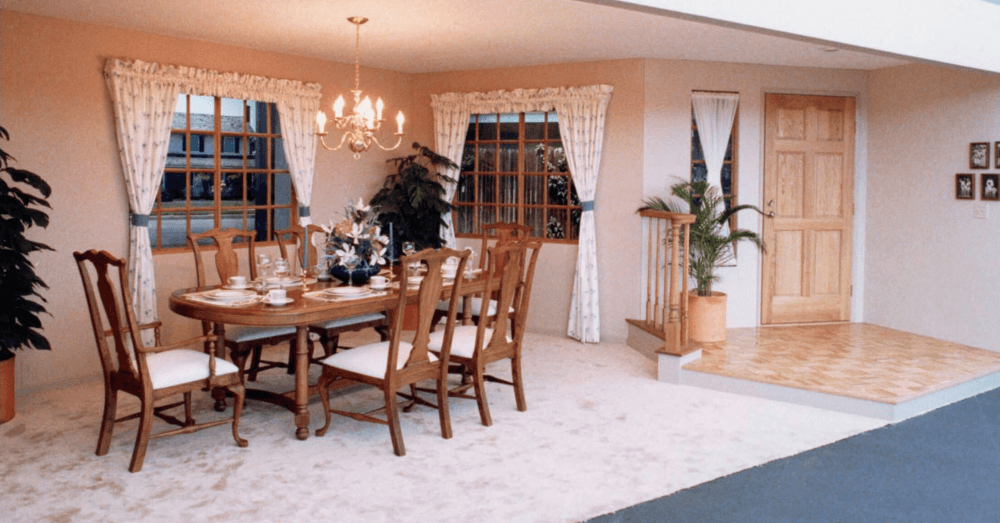
Forty years ago, Toyota pulled off one of the most unusual product research experiments in automotive history. The company’s California-based design team shipped an entire replica of an American dining room to Japan, set it up for executives to walk through, and used it to reshape how Toyota thought about its U.S. customers. That single room changed how the automaker approached everything from seat size to interior comfort, and you can still see the influence today in vehicles from the Camry to the Corolla Cross.
- Calty Design Research took a creative approach in 1986 by shipping a full mock American dining room to Japan for executives to walk through.
- A recurring point of friction between Calty and Toyota HQ was the concept of scale, as Japanese employees didn’t understand why Calty’s proposals were sized as they were, with proportions that would never fly on Japan’s narrow roads.
- Toyota learned from the experience, honing its products for Americans until the company truly took the market by storm in the following decade.
Why Toyota Needed an American Reality Check
Forty years ago, Toyota was a challenger, not a colossus. Back then, the company claimed 8% of the world’s car market, while Ford owned 12.5% and General Motors held 19%. Toyota had big ambitions, and to make them come true, the company would have to do better in the US market.
In the States, it was Calty Design Research, Toyota’s California studio opened in 1973, that helped corporate leaders back in Japan understand what American customers needed. Calty’s job was to serve as a long-term design center in America, one tuned to American tastes and proportions rather than what sold back home in Japan.
But the team at Calty kept running into a wall. One point of friction between Calty and Toyota HQ was the concept of scale, as Japanese employees who had never made the journey overseas didn’t understand why Calty’s proposals were sized as they were. On one occasion, Calty staffers even took along soda cans to show the differences in size between beverage cans in the U.S. and Japan, but this was still not enough.
A Sitcom Set That Changed Everything
They made their point better in 1986, in a manner as elaborate as it was effective. Calty traveled to Japan with all the pieces to build a model dining room typical of an American home. They set up a large wooden dinner table that seated six, with place settings to match, under a chandelier. The walls held wide windows looking out into suburbia, flanked by curtains of the proper length.
It was a full-blown sitcom set. Everything from a front door to parquet floors, plants, and family photos was accounted for, all to help Calty’s Japanese colleagues understand who they were selling to and what these consumers were used to in everyday life.
Toyota executives, including former president Hiroshi Okuda, surveyed Calty’s mock American dining room in 1986. The room showed them American size, but also the expectation of a certain kind of luxury and comfort. It was a fairly large dining table with six chairs arranged around it, and those chairs likely seemed far apart to the Japanese executives.
This exercise was most useful for interior design, as American passengers were generally larger than their Japanese counterparts, requiring more space and larger seats.
From a Dining Table to World Domination
The dining room demo worked. Toyota learned from it, honing its products for Americans until the company truly took the market by storm in the following decade. In 1980, Toyota’s market share in the U.S. was a mere 6.6 percent, but by 2009, it reached 16.7 percent.
Toyota expanded into luxury cars in the 1980s, pickup trucks in the 1990s, and hybrids in the 2000s, becoming the world’s largest automaker by volume in 2008 by surpassing General Motors for the first time. That trajectory from underdog to global leader had roots in small, deliberate acts of empathy, like stepping into a fake dining room and really looking around.
Few outside Toyota know about the dining room demo. A Calty representative told The Drive that it had only ever been shared in a coffee table book that the design studio printed in very limited numbers to commemorate 50 years in business. The book was made in 2023 but never sold to the public.
A Lesson Worth Stealing
What makes this story so useful is how simple the idea was. Toyota didn’t commission a million-dollar consumer study. They didn’t fly executives to hundreds of American homes. They built one room and said, “Stand in it. Look around. This is who you’re building cars for.”
To succeed in the American market, the Japanese executives first needed to understand Americans, their size, their expectations, how they think about comfort, and what they consider normal in daily life. A Corolla Cross sitting in a suburban driveway today is, in a small way, connected to that fake dining room from 1986.
Whether you’re designing a car, launching a product in a new country, or trying to reach an audience you don’t fully know, the Toyota dining room story is a reminder that empathy starts with experience. You can read all the reports and market data you want. Sometimes you just need to stand in someone’s dining room, even a fake one, and pay attention.
